The new Streaming Content Laws coming effect on the 1st January 2026 creates a framework for major streaming platforms operating in Australia to be legally required to invest in new Australian productions. This is the first time SVODs have faced any obligation to support local content.
The requirement applies to services with more than one million Australian subscribers. Netflix, Stan, Amazon Prime Video, Disney+, Paramount+ and Binge are all expected to be captured. Apple TV+ will be included once it crosses the subscriber threshold.
Table of Contents
Two Compliance Options
Platforms must choose one of two methods for meeting their obligation.
Option 1: Expenditure-based (10%) Platforms invest at least 10% of their total program expenditure on new Australian commissions or first-release acquisitions.
Option 2: Revenue-based (7.5%) Platforms invest at least 7.5% of their Australian subscriber and advertising revenue.
The revenue option exists at 75% of the expenditure threshold to accommodate different business models and provide flexibility for platforms whose program expenditure may be difficult to calculate or verify.
During the House of Representatives debate on 25 November 2025, Arts Minister Tony Burke indicated he would like to see the expenditure obligation increase to 13-14% at the four-year review, equivalent to approximately 9.75-10.5% of revenue. This was in response to questioning from the Member for Wentworth, Allegra Spender.
How Expenditure Is Calculated
Total program expenditure includes all money spent on acquiring or commissioning programs for the Australian service, excluding news and sport. Critically, it must include a proportionate share of “global content” – programs like The Crown, Stranger Things, or The Mandalorian that are produced for worldwide release rather than licensed specifically for Australia.
Each platform must ascribe a “transfer price” to this global content reflecting what it would reasonably cost to license for the Australian market. This prevents platforms from claiming minimal Australian-specific expenditure and avoiding their obligations.
Qualifying expenditure (what counts towards meeting the requirement) includes amounts spent on commissioning new Australian content or acquiring first-release Australian content. The content must not have been previously available to Australian audiences, with an exception for theatrical film releases.
Production budget contributions, licence fees, and commissioning payments all count. However, as noted below, government offset contributions are also included, which reduces the platforms’ net investment.
Administrative Requirements
Each regulated streaming service will need to establish compliance infrastructure. The regulatory impact analysis estimates compliance costs of $1.17 million annually across the seven affected platforms, suggesting each service will require dedicated personnel to manage reporting obligations.
Reports must be submitted to the ACMA within 45 days of each reporting year’s end, detailing program expenditure, Australian revenue, subscriber numbers, and qualifying Australian content expenditure.
Services approaching the one million subscriber threshold must notify the ACMA when they reach 250,000 subscribers, and again if circumstances change materially.
What’s Not Covered
User-Generated Platforms
Services where the primary content is uploaded by users rather than commissioned or acquired by the platform are explicitly excluded. TikTok, YouTube, Facebook, and Instagram are not captured by this legislation, even though they distribute significant amounts of video content to Australian audiences.
The exclusion applies to services where user-generated content forms the predominant offering, recognising these operate under fundamentally different business models to subscription streaming services.
Limited Appeal Services
Niche or specialty streaming services are excluded under “limited appeal” provisions. This covers services offering content only to a special interest audience (such as a particular sport, hobby, or professional field), content available only in limited geographic locations within Australia, content available only for a limited time period, or programs that would have limited appeal to the general Australian public.
This exemption ensures the obligations target mainstream entertainment platforms rather than specialist services like fitness apps, educational platforms, professional training services, or niche hobby content providers.
Small Platforms
Any service with fewer than one million Australian subscribers is exempt, allowing new entrants and smaller players to establish themselves before facing regulatory obligations.
Eligible Genres
The obligation covers drama, documentary, children’s programming, arts programs, and educational content.
Reality television does not count. Programs depicting real events or people with “a heavy emphasis on dramatic impact or entertainment value” are explicitly excluded, as are quiz shows and game shows.
News and sport are also excluded.
The Australian Content Test
The legislation adopts definitions from the existing Broadcasting Services (Australian Content and Children’s Television) Standards 2020, which govern free-to-air television.
A program qualifies as Australian if it is made under Australian creative control. This means an Australian producer, plus either an Australian director or writer, plus at least half the lead cast being Australian citizens or permanent residents. Drama productions require 75% of the major supporting cast to be Australian. The program must be produced and post-produced in Australia, though principal photography can occur overseas under section 10(2)(e).
Animation has specific requirements covering production designers, character designers, layout artists, storyboard artists, and background artists.
Official international co-productions and New Zealand content also qualify.
How It Will Be Enforced
The ACMA oversees compliance. Platforms must report annually on their expenditure.
Penalties for non-compliance are substantial. The maximum is either 10,000 penalty units ($3.13 million) or ten times the unmet expenditure requirement, whichever is greater. A platform with a $20 million annual obligation that fails to comply could face penalties exceeding $200 million.
Importantly, paying a penalty does not discharge the underlying obligation. Unmet requirements continue to accumulate until acquitted, potentially triggering additional penalties each year.
The ACMA can issue formal warnings, infringement notices, enforceable undertakings, remedial directions, and injunctions. Anti-avoidance provisions allow the regulator to pierce corporate restructures designed to circumvent the rules.
Flexible Carry-over Expenditure
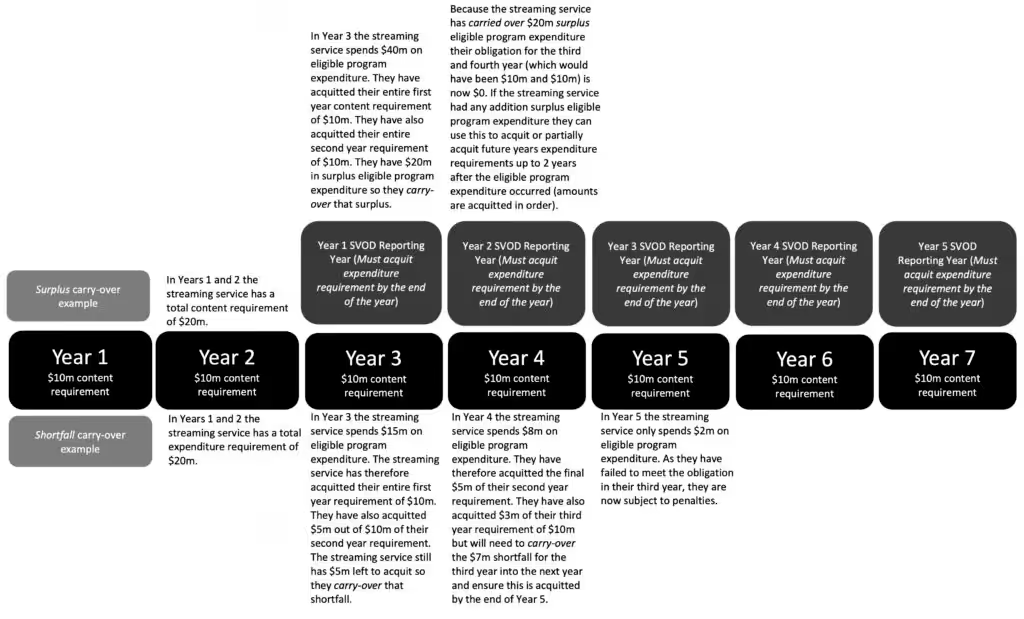
Platforms have a three-year carry-over period to balance their obligations across production cycles. Shortfalls in one year can be made up in subsequent years. Excess spending can be carried forward for up to two years. This acknowledges the lumpy nature of production investment, where significant expenditure occurs during principal photography while development years may show lower outlays.
There are no sub-quotas mandating minimum spending on particular genres. Platforms can allocate their investment across drama, documentary, children’s and other eligible categories however they choose.
Practical Impact
The government estimates this will generate $175-200 million annually in new Australian content, equating to roughly 48-53 hours of programming across all platforms each year.
Critical Gaps and Concerns
1. The Real Numbers Are Lower Than They Appear
Government production incentives are counted towards meeting the expenditure requirement. The Producer Offset provides a 40% rebate for theatrical features and a 30% rebate for television drama and other formats. The Location Offset provides a 30% rebate for large-budget productions filming in Australia. The PDV Offset provides a 30% rebate for post, digital and visual effects work.
These offsets reduce what platforms actually spend out of pocket. A television drama production attracting a 30% Producer Offset means the streamer’s real contribution is reduced accordingly. Productions filming in Australia that also access the Location Offset see even greater reductions in the platform’s net investment.
Across the industry, actual new private investment is likely to be significantly below the headline figures, with Australian taxpayers effectively subsidising platforms meeting their obligations through existing screen incentive programs.
2. Artificial Intelligence
The legislation contains no provisions whatsoever addressing AI in screen production.
The ACCTS 2020 definitions assume human creators in every role. There is no consideration of AI-generated scripts, synthetic voices, digital performers, AI-assisted animation, or any other emerging technology.
No disclosure requirements exist. Productions need not declare any use of AI tools. Audiences have no way of knowing whether content was created with AI assistance.
A production could theoretically rely heavily on AI systems for writing, voice work, or visual effects while still satisfying the Australian creative control test, provided the credited humans supervising those systems are Australian.
This is a significant gap that will require amendment as AI tools become standard in production workflows.
3. No Protection for Specific Genres
Documentary makers and children’s content producers advocated strongly for dedicated sub-quotas. Neither was included. Platforms could meet their entire obligation through drama commissioning alone, leaving other genres without guaranteed support.
4. Major Platforms Excluded
The exclusion of user-generated platforms means some of the largest distributors of video content in Australia face no local content obligations whatsoever. TikTok, YouTube, Facebook and Instagram collectively reach more Australians than traditional streaming services, yet remain entirely unregulated in this space.
The Bigger Picture
This legislation brings Australia into line with France, Italy, Spain, Canada, parts of the European Union, and other jurisdictions requiring streaming platforms to invest locally.
For context, Netflix alone has committed €1 billion to Spanish production (2025-2028) and US$2.5 billion to Korean production (2023-2027). Both figures exceed the entire reported SVOD investment in Australian content since voluntary reporting began in 2019, despite Australia having comparable or larger subscriber bases.
A statutory review will occur after four years, providing an opportunity to address shortcomings and strengthen requirements based on real-world data.
What the New Streaming Content Laws Mean in Practice
For the first time, streaming platforms operating in Australia have a legally enforceable obligation to invest in new Australian stories. This provides structural certainty that voluntary arrangements never could.
However, expectations should be tempered. The real investment is lower than headline figures suggest once government offsets are factored in, the absence of genre protections leaves documentary and children’s content vulnerable, user-generated platforms escape any obligation entirely, and the complete lack of AI provisions means the framework is already behind the curve.
The four-year review will matter enormously.
Resources:
- Save Australian Stories