I have worked as a freelance documentary cameraman Australia wide for more than 22 years, and as an Australian director of photography on larger productions. I am based in Sydney and travel for shoots, working with broadcasters, streamers, production companies and brands, from single operator observational work through to multi camera sport and events.
Documentary asks different things of a documentary cinematographer than drama or commercials do. You are often in a small crew, in conditions nobody controls, with no second take. The job is to read a room quickly, light it without killing what is actually happening, and come back with coverage that cuts together.
Documentary credits
A selection of the documentary and factual work I have shot.
| Production | Year | Director | Production company |
|---|---|---|---|
| In Pieces Together: Everyone Deserves to Feel Awesome | 2026 | Macario De Souza | Hype Republic |
| Voyagers: Exploring Pacific Waters | 2026 | Daniel Sharp | Dash Pictures |
| Drive to Survive S8 | 2026 | Rob Wills | Box to Box |
| Gladiators: Warriors of the Ancient World | 2025 | Daniel Sharp | Dash Pictures |
| Untitled de-extinction documentary | 2025 | Alex Reynolds | Underdog Films |
| Netflix ‘Break Point’ S2 | 2024 | Martin Webb | Box to Box |
| Octopus! | 2023 | Sandi Tan | Jigsaw Productions |
| FIFA Women’s World Cup ‘Moments’ | 2023 | Eddie O’Rourke | FIFA Studios x Good Shout |
| Apple TV+ ‘Make or Break’ S2 | 2023 | Warren Smith | Box to Box |
| Netflix ‘Break Point’ S1 | 2023 | Martin Webb and Toby Oppenheimer | Box to Box |
| Untitled Jeff Fenech documentary | 2023 | Macario De Souza | Hype Republic |
| Apple TV+ ‘Make or Break’ S1 | 2022 | Warren Smith | Box to Box |
| Make it Delicious | 2022 | Peter Burge | PDB Creative / News Corp |
| FIFA Women’s: All Roads Lead Downunder | 2022 | Jamie McIntosh | Whisper TV |
| The Rollout | 2021 | Eran May | Sima Films |
| CSIRO ‘The Dish’ in 3D | 2021 | Russell Scott | Swinburne University |
| The Big Shift | 2020 | Caroline Stocker Stratman | Goodhope Productions |
| Pipe Dreams | 2018 | Ben Gregg | Chrome Creative |
| Untitled Opera House documentary | 2018 | Tim Slade | Vast Productions |
| What Will Become of Us | 2017 | Steven Cantor | Stick Figure Productions |
| Cape Fear | 2017 | Macario De Souza | Red Bull Media House |
| Thrown Into This World | 2017 | Antra Cilinska | Jura Podnieka Studija |
| You See Monsters | 2017 | Tony Jackson | Chemical Media |
| Happy Sad Man | 2016 | Genevieve Bailey | Proud Mother Pics |
| Re-Design My Brain S2 | 2015 | Jeff Siberry | Mindful Media |
| The Surgeon and the Soldier | 2014 | Martin Taylor and Margie Bryant | Serendipity Productions |
| 35 Letters | 2014 | Janine Hoskings | iKandy Films |
| Making Families Happy | 2014 | Martin Taylor | Heiress Films |
| The Memorial: Beyond the Anzac | 2014 | Janine Hoskings | Eyeworks Australia |
| Zach’s Ceremony | 2013 | Aaron Petersen | Postbox |
| Legacy: A Ride to Conquer Motor Neurone Disease | 2013 | Tony Prescott | Teapot Films |
| Storm Surfers 3D | 2011 | Justin McMillan and Chris Nelius | Sixty Foot Films |
| Untitled Rob ‘Razor’ Wilkinson documentary | TBC |
Some of that work has been recognised. Storm Surfers 3D won Best Feature Length Documentary, and I won the International 3D Society award for Best 3D in a Documentary on the same film. I have been nominated by AACTA for Best Cinematography in a Documentary, and have received awards from my peers at the Australian Cinematographers Society. Zach’s Ceremony won the Audience Choice Award at both SIFF and MIFF, and 35 Letters won Best Documentary at SIFF.
What a documentary DOP actually does on your production
The title covers a lot of ground. On a small documentary I am often operating, lighting and pulling my own focus. The right answer depends on your budget and what the story needs. If you are working out what level of crew a project actually needs, the practical difference between a cinematographer and a videographer is the right place to start.
Observational and verite
Handheld, available light, staying out of the way. Working as a single operator matters here, because a smaller footprint in the room gets you closer to the moment. The skill is anticipating where it is going and being in the right position before it happens, rather than chasing it afterwards.
Interviews
A considered set up that suits the subject and matches the rest of the film. Two camera where the budget allows, so the edit has somewhere to cut. See the interview lighting setup guide for how I usually approach this.
Sport and action
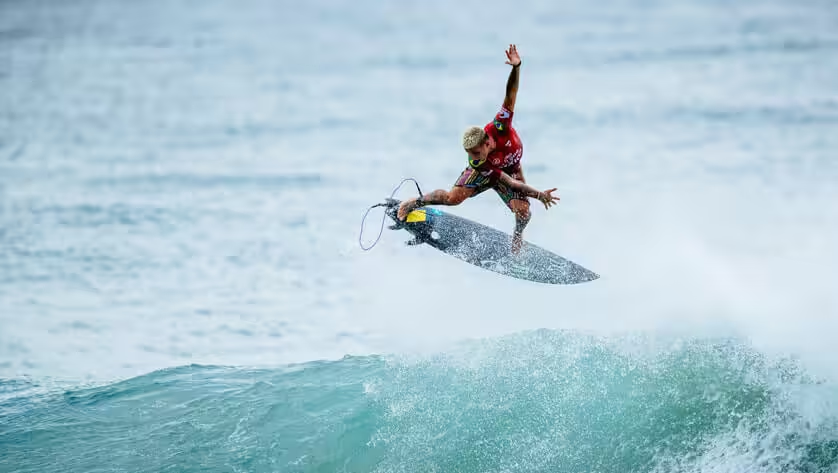
Long lens work, high frame rates and shooting to a schedule you do not control. Break Point, Make or Break and the FIFA Women’s World Cup were all built on this. More on that in how to shoot a sports documentary.
Remote and difficult conditions
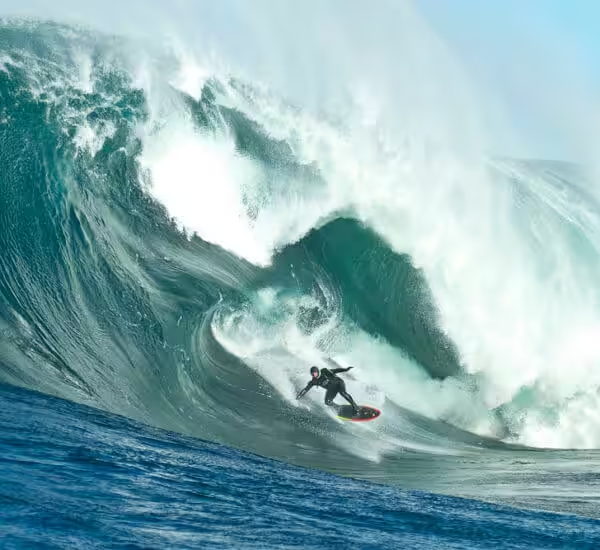
Heat, water, dust, altitude and long travel days. The planning matters more than the gear. See filming in extreme environments.
Documentary cameraman Australia wide
I am based in Sydney and travel anywhere in Australia. Most documentary work involves moving, so a national schedule is normal rather than an exception.
How the equipment travels depends on the distance. For Sydney, Melbourne, the Sunshine Coast and regional New South Wales, Queensland and Victoria, I drive. That means a van and a full kit, so the shoot is not limited to what fits in a flight case.
For anywhere else in the country I fly in with a reduced travel kit, sized to what the job actually needs. Either way the decision gets made in prep rather than on the day. A full list of what I own is on the equipment page.
I have also put together filming location and permit guides for the cities I work in most often, which are useful at the planning stage. Screen Australia is worth a look if you are still costing a project.
Sydney · Melbourne · Brisbane · Perth · Gold Coast · Adelaide · Hobart
Common questions
What is the difference between a documentary cameraman and a director of photography?
In practice the terms overlap, and on a small documentary they are the same person. A cameraman or camera operator runs the camera. A director of photography is responsible for the look of the film as a whole, which includes lighting, lens choice, camera movement and, on larger productions, leading the camera team. On documentary the DOP is very often operating as well. The Australian Cinematographers Society is the professional body here.
Do you shoot outside Sydney?
Yes, anywhere in Australia. I work as a documentary cameraman Australia wide, driving to Melbourne, the Sunshine Coast and regional New South Wales, Queensland and Victoria, which means I arrive with a van and a full kit. Further afield I fly with a reduced travel kit.
Can you work as a one person crew?
Yes. A lot of observational documentary is shot that way, and it is often the right call when a small footprint matters more than a big setup. For interviews and larger shoots I bring or recommend the crew the job needs.
Do you bring your own equipment?
Yes. Within driving range I travel by van with a full kit. On fly-in shoots I bring a reduced travel kit and we plan the rest around what the production needs. The equipment page lists what I own.
What formats do you shoot?
Feature documentary, documentary series, sports documentary, branded documentary and factual content for broadcast and streaming.
Are you available as an Australian DOP for branded and factual work?
Yes. Alongside documentary I work as an Australian DOP on branded, factual and commercial productions across the country, either as a freelance owner operator with my own kit or leading a camera team on larger jobs.
Do you work as a freelance camera operator as well as a DOP?
Yes, and both are normal on factual work. On a small documentary I am often the whole camera department, operating, lighting and pulling my own focus as an owner operator with my own kit. Other shoots book me purely as a freelance camera operator working to someone else’s lighting plan, and that is fine too. Tell me which the job needs and the crew and kit get sized to match.
What is the difference between a documentary cinematographer and an ENG camera operator?
ENG and EFP work is built for speed. One operator, a run and gun kit and a turnaround measured in hours, which is exactly right for news and fast factual. A documentary cinematographer is working to a longer arc, making lighting and lens decisions that have to hold across weeks of shooting and still cut together months later. Plenty of productions need both in the same week. The practical question is whether you are buying coverage or buying a look, because that changes the kit, the crew and the schedule.
How much crew do you need for a documentary shoot in Australia?
It comes down to access and schedule more than budget. Observational and verite work is often better with one person in the room, because a smaller footprint gets you closer to the moment. Interviews usually want a second pair of hands for lighting and sound. Once you are running multiple set-ups or long days, a focus puller and a gaffer pay for themselves in what you actually get on the card. I would rather right-size that in prep than discover it on day one.
If you are looking for a documentary cameraman Australia wide, I am happy to talk through the approach, the crew size and the schedule before anything is locked.